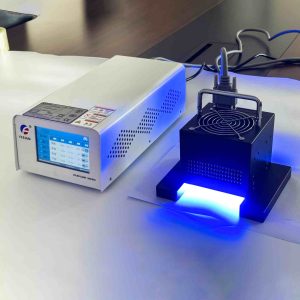
As 400G/800G high-speed optical transceiver modules enter large-scale mass production, the packaging process demands for curing equipment have become increasingly stringent. The UVLED curing chamber, a critical device in transceiver module manufacturing, is progressively replacing traditional mercury lamp solutions and becoming the mainstream choice across the industry.
UV Curing Equipment for Optical Module Packaging
Why UVLED Is Essential for Transceiver Module Curing?
Transceiver modules integrate precision components including laser diode (LD) chips, photodetector (PD) chips, lenses, and fiber array units (FAU). Their adhesive bonding and sealing protection heavily rely on high-quality UV adhesive curing. Traditional mercury lamp curing suffers from excessive thermal radiation and uncontrollable temperatures, which can easily damage thermal-sensitive components and lead to optical power degradation. As a “cold light source,” the UVLED curing chamber keeps surface temperature rise within 5°C, fundamentally preventing high-temperature damage to laser chips and precision lenses, with optical power degradation rate reduced to below 0.1 dB per 1,000 hours.
Core Selection Criteria: Wavelength, Energy, and Uniformity
1. Precise Wavelength Matching: The absorption peaks of acrylic/epoxy UV adhesives commonly used in transceiver module packaging concentrate at 360–370 nm. Therefore, 365 nm single-band UVLED point sources are the preferred solution, boosting photoinitiation efficiency by over 30% and ensuring curing depth ≥1 mm with bonding strength ≥25 MPa.
2. Micro-Zone High Energy Density: For micron-level bonding points between fiber arrays and lenses in high-speed QSFP-DD/OSFP modules, the spot diameter needs to support Φ1–5 mm adjustable range, with irradiance ≥2000 mW/cm² and closed-loop feedback fluctuation ≤3% to meet precision curing requirements.
3. Illumination Uniformity: Area light source design must guarantee illumination uniformity above 90%, ensuring uniform UV adhesive curing across TOSA/ROSA component surfaces and gaps, preventing optical path deviation caused by insufficient local adhesive strength.
Typical Application Scenarios
In fiber array (FA) to PLC chip bonding, UVLED curing chambers achieve rapid 3–5 second curing with insertion loss deviation <0.05 dB. In TOSA/ROSA component packaging, combined with automatic alignment systems, shadow-free curing can be realized with hermetic seal pass rates improved to 99.5%. For lens and fiber end-face fixation, precise light control optimizes coupling efficiency from 0.7 dB to 0.25 dB.
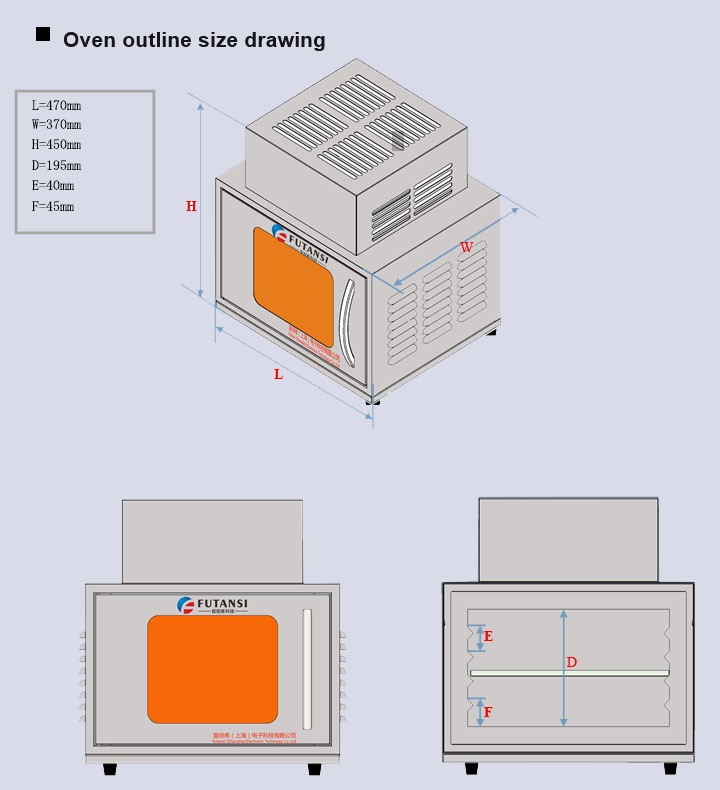
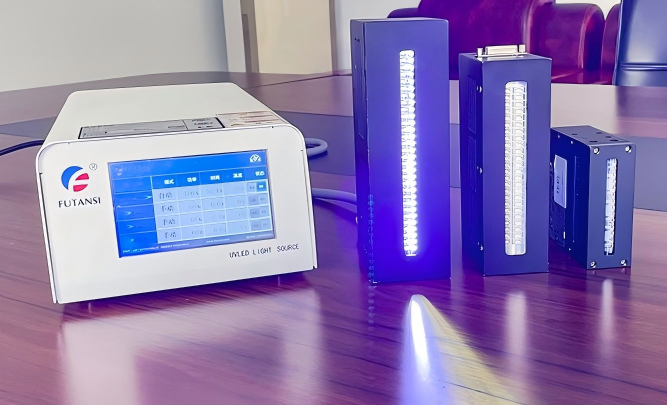
Current mainstream UVLED curing equipment supports one-to-four multi-channel independent control for synchronous/asynchronous operation, adapting to multi-station production lines with capacity reaching 1,500 units per hour. Devices are generally equipped with RS232/485 interfaces for MES system integration and curing data traceability. Some manufacturers also offer light field simulation services to optimize the relative angle between light source and fiber array, ensuring energy coverage uniformity >95%.
About Futansi
As one of the leading UV curing equipment manufacturers in the optical communications sector, Futansi delivers best UV curing light technology that outperforms traditional UV curing bulb and legacy Dymax UV curing alternatives. Our comprehensive portfolio of UV curing devices, UV curing dryers, and specialized acrylate UV curing systems provides complete adhesive UV curing solutions for the most demanding precision manufacturing applications.
Futansi Electronic Technology, established in 2010, has emerged as a leading UV curing equipment manufacturer specializing in innovative LED UV curing solutions for industrial adhesive applications. As a trusted name among UV curing equipment manu...
Photovoltaic silicon wafers serve as the core material of solar cells, requiring precise processing with various chemicals and adhesives. Traditional curing methods using conventional UV A curing lamps consume significant energy and occupy substan...
In the UVLED curing equipment industry, many manufacturers invest heavily in thermal design simulations to ensure devices operate within safe temperature ranges. Yet one critical question often gets overlooked: what happens when temperatures rise ...
Futansi's UV curing dryer technology not only enhances the manufacturing precision and production efficiency of optical communication devices but also drives the industry's transition toward sustainability. Unlike legacy Dymax UV curing systems an...
 A professional manufacturer of UVLED curing systems
韵色.jpg)

韵色-300x300.jpg "Futansi: Advanced UV Curing Equipment for Next-...")
Faydalı bilgilerinizi bizlerle paylaştığınız için teşekkür ederim.
2026-05-1521:12
I really like reading through a post that can make men and women think. Also, thank you for allowing me to comment!
2026-05-1521:15
Hi there to all, for the reason that I am genuinely keen of reading this website’s post to be updated on a regular basis. It carries pleasant stuff.
2026-05-1521:18
Yazınız için teşekkürler. Bu bilgiler ışığında nice insanlar bilgilenmiş olacaktır.
2026-05-1521:28
Very well presented. Every quote was awesome and thanks for sharing the content. Keep sharing and keep motivating others.
2026-05-1521:30
This is my first time pay a quick visit at here and i am really happy to read everthing at one place
2026-05-1521:33
I appreciate you sharing this blog post. Thanks Again. Cool.
2026-05-1521:36
This was beautiful Admin. Thank you for your reflections.
2026-05-1521:41