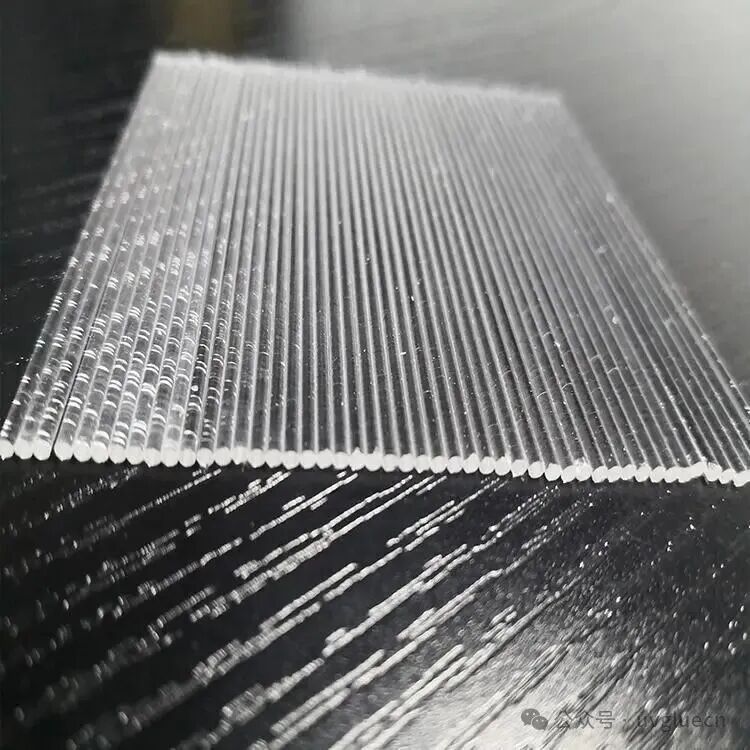
Fiber Array (FA) is not a single optical fiber, but rather a high-precision optical component formed by arranging multiple fibers (such as 4-core, 8-core, 12-core, 24-core, or even more) at fixed pitches (typically 127 μm or 250 μm) and securing them into V-grooves on a substrate (usually silicon or glass).
FA array polishing refers to the process of implanting multiple fibers at precise pitches into a substrate (silicon, glass, or quartz) with V-grooves, followed by cutting, grinding, and polishing the end face to form an optically flat and smooth surface (flat PC, spherical PC, or angled APC), thereby enabling efficient, low-loss optical signal coupling and connection.
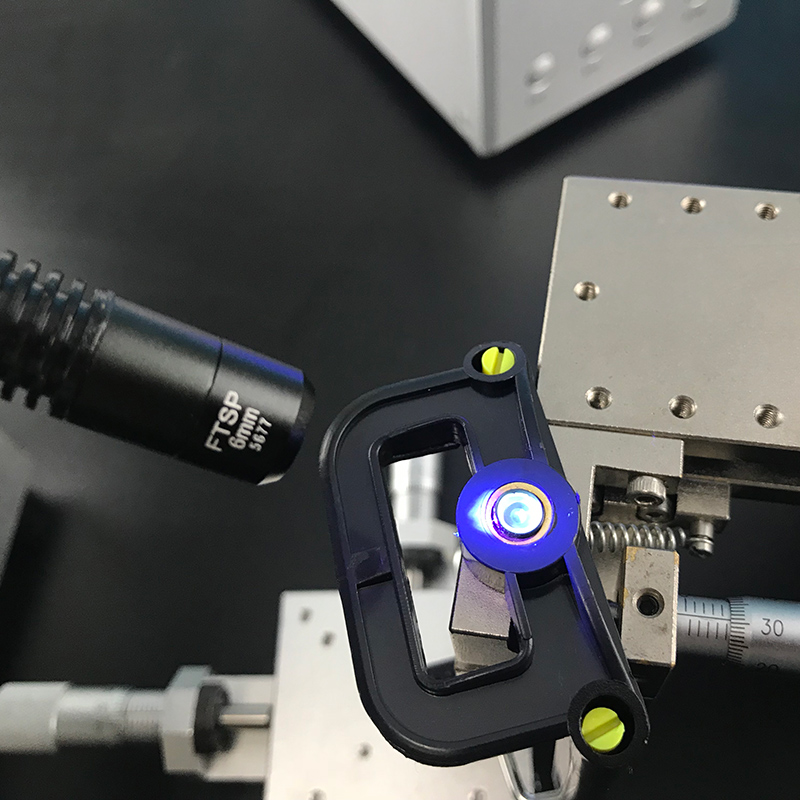
auto coupling system
Core Objectives:
Achieve high-precision fiber alignment;
Minimize Insertion Loss (IL) to ensure smooth optical power transmission through the connection point;
Maximize Return Loss (RL): Through specific end-face geometries (especially APC), reflected light is reduced to the lowest possible level, ensuring stable laser operation.
FA polishing is not performed arbitrarily; it is mainly classified into the following three types based on its optical function:
1. Flat / PC Polish The fiber end face is polished into an absolutely flat and smooth vertical plane (perpendicular to the fiber axis).
Reflection reduction: High-precision polishing makes the end face as smooth as a mirror, reducing scattering loss;
Physical contact: Used in applications requiring direct physical contact (butt coupling) between two fiber end faces to ensure maximum contact area;
Applications: Multimode fiber connections, certain internal connections.
2. PC (Physical Contact) The fiber end face is polished into a tiny spherical (convex) surface.
Air-gap elimination: When two PC end faces mate, the spherical design ensures that only the central portion makes contact, using the elasticity of the fiber to expel air from the contact zone. This greatly reduces Fresnel reflection and lowers return loss;
Improved reliability: Prevents dust from being trapped between end faces;
Applications: Early fiber connectors (e.g., FC/PC), certain internal optical module connections.
3. APC (Angled Physical Contact) The fiber end face is polished at a specific angle (typically 8°).
Complete reflection elimination: This is the most common and demanding process in FA polishing. According to optical principles, when light travels from the fiber (high refractive index) to air (low refractive index), if the end face is perpendicular, approximately 4% of the light is reflected back. This causes laser instability and increased signal noise. By polishing the end face to an 8° angle, reflected light does not return along the original path into the fiber core but is instead deflected into the fiber cladding and dissipated. APC end faces can provide extremely high return loss (typically >60 dB), which is a mandatory requirement for modern high-speed optical communications (such as FTTH, 5G fronthaul, and data center interconnects).
UV Curing Equipment for Optical Module Packaging
High-Efficiency UV Curing Equipment for Optical Module Packaging
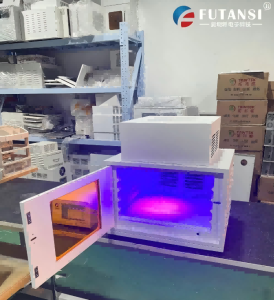
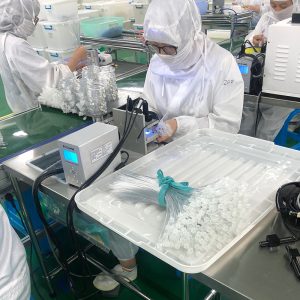
Currently, the new industry standard for FA array fiber angle polishing adopts temporary bonding UV adhesive, cured with UVLED curing equipment, completely solving the fatal drawbacks of traditional wax processes.
1. Core Advantages:
Liquid gap-filling: Before curing, it is a liquid that can flow like water into the finest gaps, ensuring 100% support between fibers and preventing edge collapse;
Solid rigidity: After irradiation by a UVLED curing system, the adhesive instantly transforms into a hard, glass-like solid (hardness Shore D>80), locking the fiber array into a monolithic structure like cement. This ensures zero deformation during grinding, guaranteeing the precision of the angle and flatness;
Low-temperature, non-damaging: Modern UVLED curing equipment employs cold-light-source technology with virtually no infrared thermal radiation. The workpiece surface temperature rise during curing is ≤5°C, avoiding thermal damage to fiber coatings, plastic components, and PLC chips caused by the high temperatures of traditional mercury lamps, and ensuring waveguide refractive index stability;
Chemical resistance: The cured adhesive layer can resist erosion from polishing slurries (ethylene glycol-based, aluminum oxide/silica suspensions).
2. Key Role of UVLED Curing Process
UVLED curing equipment is the core apparatus that transforms FA temporary protective adhesive from “liquid gap-filling” to “solid rigidity.” Its technical characteristics directly determine grinding precision:
Precise spectral matching: Utilizing 365 nm/385 nm/395 nm wavelengths, it precisely matches the absorption peaks of the UV adhesive photoinitiators, with a compatibility rate exceeding 98%, ensuring synchronous curing of deep adhesive layers;
Programmable alternating high/low irradiance: To avoid internal stress concentration, cover plate debonding, or deformation displacement caused by one-time high-irradiance curing, advanced UVLED curing machines support programmable irradiance control. For example, a preliminary exposure at 20 mW/cm² low irradiance for 30 seconds allows the adhesive to initially set and release partial stress; it then automatically switches to 80 mW/cm² high irradiance for 30 seconds to complete full curing. This “low-stress curing” mode is crucial for ensuring sub-micron alignment precision;
Multi-form light source adaptation:
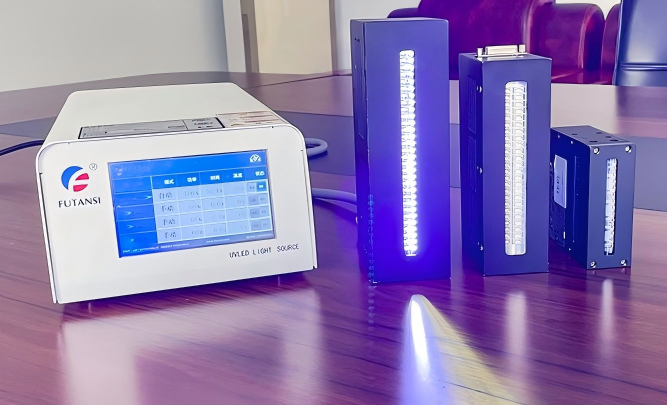
UVLED spot source: Suitable for local supplementary curing or precise curing of single-channel FAs;
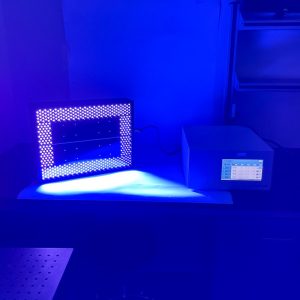
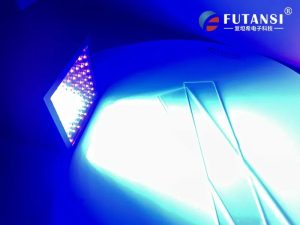
UVLED area source: Suitable for synchronous and uniform curing of entire multi-core FA arrays, with energy uniformity reaching ±3%, ensuring consistent force on each fiber;
UVLED line source / tunnel curing machine: Can be integrated with production lines to achieve continuous inline curing, significantly improving production efficiency;
High efficiency and environmental protection: UVLED equipment consumes only 20% of the energy of traditional mercury lamps, contains no mercury or other hazardous substances, boasts a service life exceeding 20,000 hours, requires no warm-up, and is ready to use immediately upon switching on.
3. Key Feature: Water-Soluble Removal
Non-damaging cleaning: No need for strongly corrosive acetone, avoiding solvent damage to fiber coatings or plastic components, achieving residue-free, non-damaging cleaning.
Debonding principle: After polishing is completed, the entire assembly is soaked in hot water at 60–80°C. The adhesive absorbs water, swells, softens, and finally peels completely away from the fiber surface;
About Futansi
As one of the leading UV curing equipment manufacturers in the optical communications sector, Futansi delivers best UV curing light technology that outperforms traditional UV curing bulb and legacy Dymax UV curing alternatives. Our comprehensive portfolio of UV curing devices, UV curing dryers, and specialized acrylate UV curing systems provides complete adhesive UV curing solutions for the most demanding precision manufacturing applications.
As optical transceiver modules evolve toward higher speed, miniaturization, and high reliability, the UVLED curing chamber has become standard equipment in optical communication manufacturing, leveraging core advantages of "cold curing, precise en...
UVLED curing technology is profoundly transforming manufacturing processes in the medical sector with its high efficiency, environmental friendliness, and precision. As professional UV curing equipment manufacturers, we are dedicated to providing ...
In the precision manufacturing chain of the liquid crystal display (LCD) industry, UVLED curing and processing technologies have already permeated multiple critical process steps.
Compared with traditional mercury lamp solutions, UVLED is reshapi...
In the industrial curing sector, UVLED light sources are undergoing a "have your cake and eat it too" technological revolution — demanding both extreme high intensity and precise low-energy control. As a professional manufacturer with 17 years of ...
 A professional manufacturer of UVLED curing systems
韵色.jpg)

HelloPlease log in