TrendForce data shows that the global UV LED market is expected to exceed $215 million in 2026, with water-cooled UV LED curing systems becoming the preferred solution for high-intensity continuous operation scenarios due to their excellent thermal management performance.
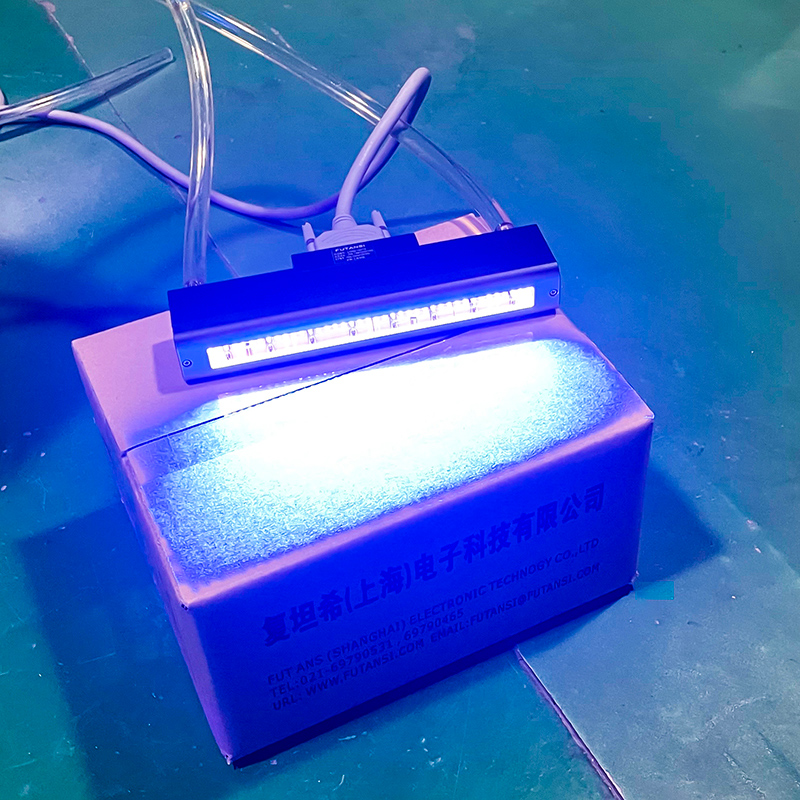
As a UV LED curing equipment manufacturer, Futansi Technology recently disclosed the “core secret” behind its water-cooled products—why distilled water is insisted upon as the cooling liquid rather than tap water, involving professional considerations in materials science and electrochemical corrosion.
auto coupling system
Customer Feedback: Stable Thermal Performance Under High-Intensity Operation
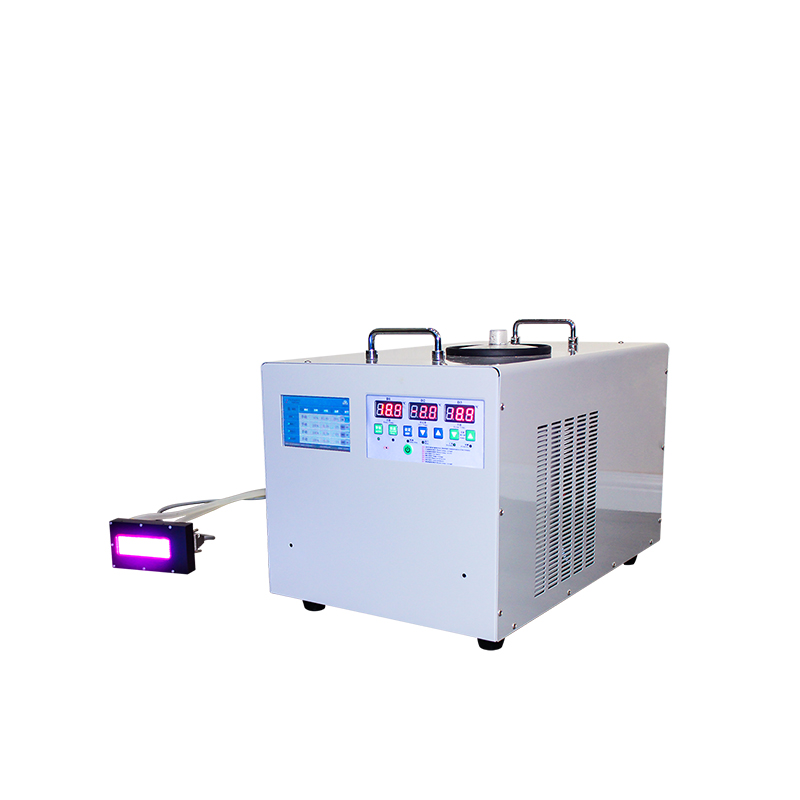
According to Futansi Technology, many customers have reported in practical use that its water-cooled UV LED curing machines not only offer fast curing speeds, but more critically, demonstrate superior thermal stability during long-term, high-intensity operation. This performance is directly related to the choice of cooling liquid for the equipment’s water chiller.
From the perspective of cooling liquid options, inhibited ethylene glycol and propylene glycol are both viable solutions. The former can effectively reduce metal corrosion and offers excellent thermal conductivity; the latter is more environmentally friendly. However, after comprehensive evaluation of environmental protection, convenience, and safety, Futansi Technology has designated distilled water as the standard configuration.
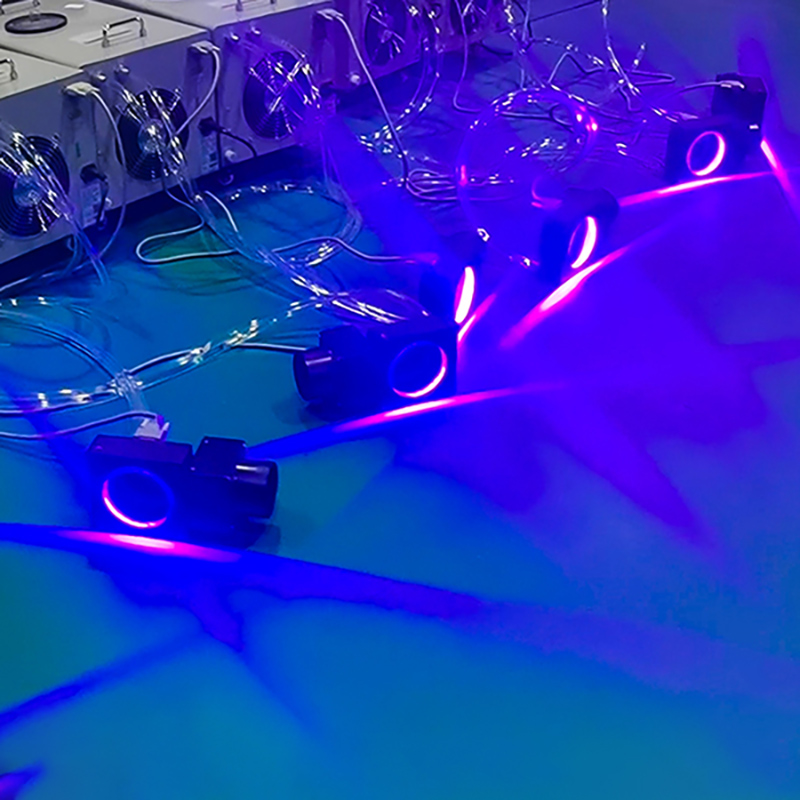
UV Curing Equipment for Optical Module Packaging
Core Advantage of Distilled Water: Ion Removal, Minimal Corrosion
Distilled water removes a large amount of dissolved ions through the distillation process, making electrochemical corrosion reactions difficult to occur. For metal joints and sheet metal structures in water-cooled systems, this characteristic significantly reduces corrosion risks during long-term operation. For those seeking higher standards, deionized water (with even lower ion concentration) can serve as an upgrade option.
Why Tap Water Is Excluded: The “Dual Destruction” of Chloride Ions
Futansi Technology explicitly excludes tap water, with the core reason being the chloride ions (Cl⁻) contained in tap water. Chloride ions play a dual role in the corrosion process: first, as an electron transfer medium, they accelerate the rate of electrochemical reactions; second, with their strong penetrating ability, they can permeate beneath corrosion product layers and continuously react with the base metal, causing corrosion to develop in depth.
This mechanism is particularly dangerous in industrial equipment water-cooled systems—corrosion not only shortens equipment lifespan but may also cause cooling liquid leakage, leading to production line downtime and even safety hazards.
Industry Background: Thermal Management Technology Becomes the Competitive Focus of UV LED Equipment
In 2026, as the global mercury ban under the Minamata Convention accelerates, UV LED equipment is comprehensively replacing traditional mercury lamps. A GM Insights report indicates that mercury replacement regulations are expected to be fully implemented by 2030, with procurement policies shifting to mercury-free default standards. In high-power UV LED applications, thermal efficiency directly determines light decay speed and equipment lifespan. Water-cooled solutions, with advantages such as uniform heat dissipation and low noise, are transitioning from optional configurations to industry mainstream.
Futansi Technology stated that the company is committed to providing complete UV LED curing solutions, with products covering both standard and customized options. For customers with water-cooled UV LED curing requirements, technical support can be obtained through the official website or phone consultation.
Under the policy background where zero-carbon factory construction mandates coverage of electronics, electrical appliances, light industry, and other sectors, professional control over “hidden details” such as cooling liquid by equipment manufacturers will become an important factor in customer selection decisions.
Futansi: A Trusted Partner for UVLED Curing Solutions
Futansi Electronic Technology has been deeply engaged in the UVLED curing field for over a decade, focusing on providing reliable curing equipment for high-end manufacturing industries such as optical communications, optoelectronics, new energy, automotive electronics, and PCBA.
Our product portfolio covers UVLED spot sources, line sources, area sources, and intelligent curing conveyor systems, fully adapting to the exposure, modification, curing, and cleaning requirements of LCD production lines.
We provide free sample machine trials and customized solution design, equipped with a professional technical team offering full-lifecycle after-sales support to help customers achieve process upgrades and cost-efficiency improvements.
UVLED curing technology is profoundly transforming manufacturing processes in the medical sector with its high efficiency, environmental friendliness, and precision. As professional UV curing equipment manufacturers, we are dedicated to providing ...
In the UVLED curing equipment industry, many manufacturers invest heavily in thermal design simulations to ensure devices operate within safe temperature ranges. Yet one critical question often gets overlooked: what happens when temperatures rise ...
Futansi's UV curing dryer technology not only enhances the manufacturing precision and production efficiency of optical communication devices but also drives the industry's transition toward sustainability. Unlike legacy Dymax UV curing systems an...
In the precision manufacturing chain of the liquid crystal display (LCD) industry, UVLED curing and processing technologies have already permeated multiple critical process steps.
Compared with traditional mercury lamp solutions, UVLED is reshapi...
 A professional manufacturer of UVLED curing systems

韵色-300x300.jpg "Futansi: Advanced UV Curing Equipment for Next-...")
HelloPlease log in